Hanoi, the millennial capital of fine cultural traditions, is the center of culture and pol - itics of Vietnam with many natural attrac- tions as well as historic sites. Coming to Hanoi, you have the opportunities to visit the ancient Turtle Tower, the Old Quarter of 36 streets whose names give each and every Hanoian a great sense of pride, etc. Even though modestly called an “area of one hundred handicraft villages”, Hanoi, the city with more than a thousand years of history, is where up to 1350 craft villages have been preserved, which cannot be found in any other place in the world.
Located not too far from the city center, Ha - noi’s craft villages lie next to the bamboo tree clusters or rivers, which are also their sources of material and transportation. Such villages are must-visit places as each of them has its own cultural features, shown through the vil - lage’s gate, the tradition of worshipping the man who first taught the villagers to do these handicraft works or sophisticatedly created products. Only about 30 kilometers from the Old Quarter, there are a large number of fa - mous handicraft villages, which are adjacent to each other, or are separated just by a pad - dy field or a river, such as Bat Trang pottery village, Quat Dong embroidery village, Trach Xa sewing village, Duyen Thai lacquer village, Chuyen My mosaic village, Nhan Hien sculp - ture village, Nhi Khe wood-carving village, Vac paper fan-making village, Chuong conical hat village, Phu Vinh bamboo-weaving vil - lage (whose spun bamboo ware products are praised as the peak of Vietnamese weaving art), etc. Though it is not able to mention all of Hanoi’s handicraft villages as well as interest - ing surprises in craft village tours, Bat Trang pottery village, Van Phuc silk village and Phu Vinh bamboo-weaving village are the most popular names of such tours in Hanoi.
Van Phuc Silk Village
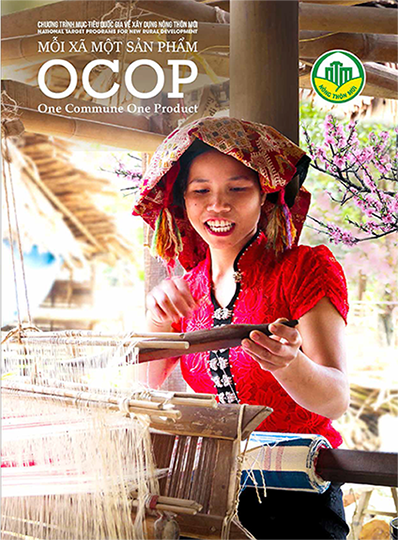
Located on the bank of the Nhue River, Van Phuc silk village still retains the original characteristics of an ancient village of Vietnam, with age old banyan trees, wells, communal house and the regular afternoon markets. Van Phuc has been famous for the traditional craft of silk weaving for a long time and the history of 1,000 years, making it recognized as “the oldest silk weaving craft village in Vietnam” recently. Van Phuc silk products have a wide range of colors and kinds (brocade, silk, chiffon, satin, etc.). In the past, Van Phuc silk was used to sew the national costumes. At Marseilla Fair in 1931, Van Phuc silk was introduced in the international market for the first time and appraised as a delicate product of Indochina by French people. Since 1990, Van Phuc silk has been exported to many countries such as France, Poland, Switzerland, Cambodia, etc. Van Phuc Silk Village Coming to Van Phuc silk village, in the joyful sounds of the looms moving back and forth, you will find yourself in a busy crowd of visitors going in and out of the shops, trying and buying silk products. The shops are placed on the side of the village’s main road, selling stunning and colorful fabrics. The silk products here are famous for being soft, light, and especially resistant and appealing, which created the brand name for this silk weaving village. Besides, when visiting this old craft village, tourists have an opportunity to observe the process of silk weaving themselves, from designing, drawing to embroidering. A tour to Van Phuc silk village will surely leave you with long-lasting and interesting impressions.
F
A place of interests that any tourist should visit when they travel to Hanoi is Bat Trang pottery village - a famous craft village of Hanoi with a history of more than 600 years. Bat Trang is located on the side of the peaceful Red river with over 2,000 ceramics factories whose products have been well known across Vietnam and even by overseas markets for decades. Bat Trang ceramic products such as flower vases, decorative vases, bowls, plates, dishes, tea sets, etc… are often decorated with the ancient patterns. They have already been exported to many countries, including Portuguese, Japanese, Holland, French and so on, around the world for hundred years in large quantities. Once visit Bat Trang, visitors should not miss an attractive Bat Trang ancient village. The small long roads are surrounded by the mossy antique brick walls, the charcoal black walls, the curving gates of the houses hidden by colorful flower trusses somewhere. It is the first feeling when people first arrive at this ancient village. In the past, Bat Trang villagers were well – off thanks to their traditional business. This can be told by looking at the tiny roads with many smaller paths that was the way they used to protect their properties, a stranger could hardly find the way out or to take something out of the village. In this ancient village, there are still some ancient ceramic furnaces used in different development periods or to make different products. In this ancient village, there are a lot of pagodas, churches, or old houses, each of which would be related to a story of love for the ceramics production of Bat Trang. Bat Trang people are very friendly and they are also good at making ceramics as well as cooking tradition foods. When tourists come across this village, they will have opportunities to try the dish of calamari mixed with bamboo shoots, crunchy sticky rice or a cup of the sip flower tea. It is hard to describe the impressions and feelings when visit Bat Trang ceramic village.
Phu Vinh bamboo and rattan weaving
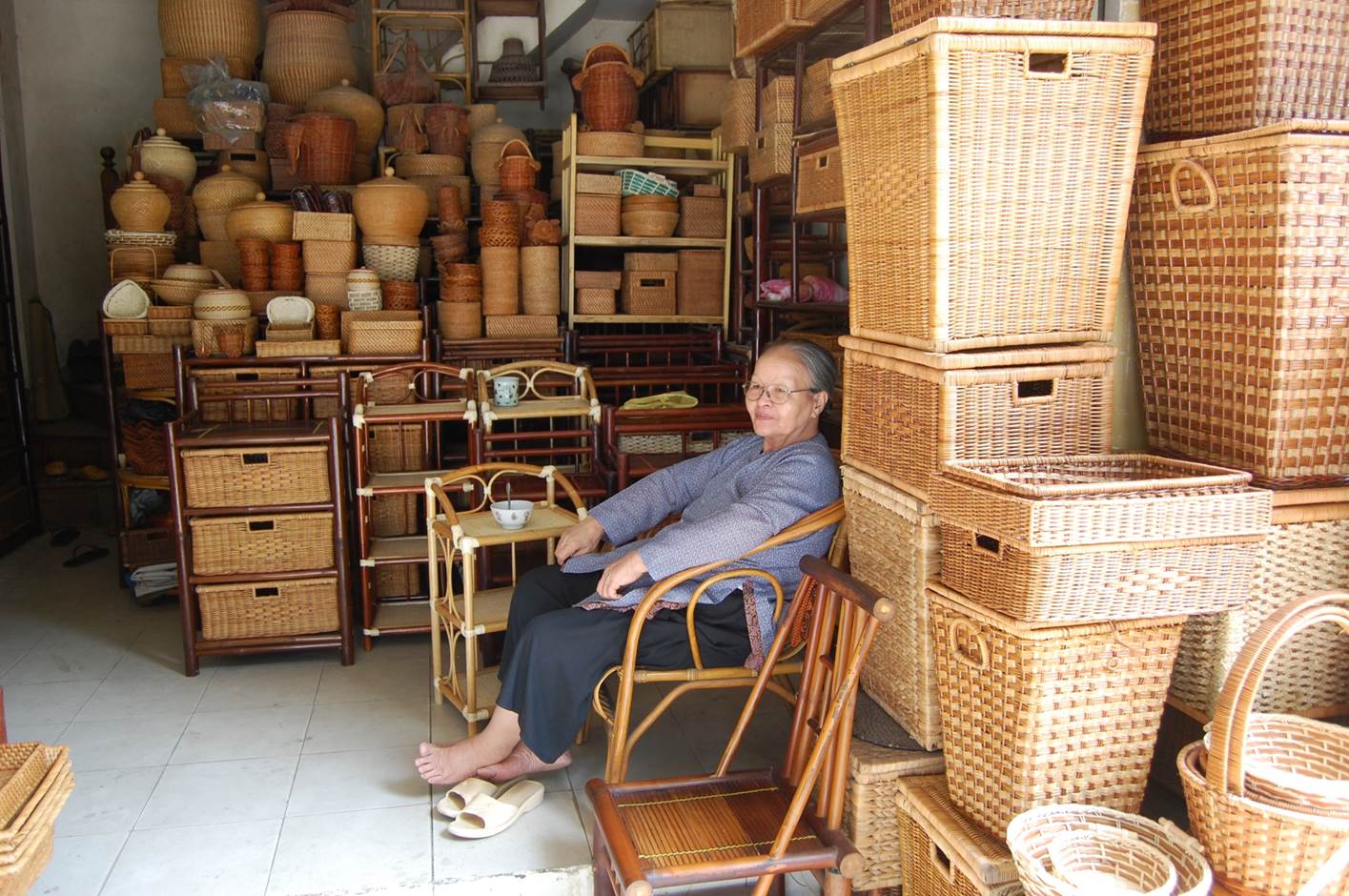
Only less than 30 minutes driving from Van Phuc village, Phu Vinh bamboo-weaving village is another handicraft attraction of Hanoi. This may be the only craft village in Vietnam where you can find the woven craftworks that you can hardly ever imagine. Phu Vinh is truly a craft village of craftsmen, or more precisely, talented artists of the bamboo-weaving art. Such craftsmen as Nguyen Van Tinh, Nguyen Van Trung, etc. here are capable of weaving soulful portraits of the nation’s leaders. It is possibly that only Nguyen Van Kha and his wife in their 60s can be the only ones in the world who are still able to make Vietnamese food cover tents by using the smallest possible rattan Phu Vinh bamboo and rattan weaving strips. Once visiting Phu Vinh village, you can also be charmed by its peacefulness which is typical of the Northern countryside with bamboo and rattan tree clusters together with attached town houses where the villagers regardless of ages or genders are gathering to weave thousands of products every day, from flower baskets, bags to storage baskets and so on. Phu Vinh is also the only village in Vietnam that produces delicate spun bamboo ware products which are praised as the best of Vietnamese weaving art. The experienced and skillful craftsmen in Phu Vinh are considered as the village’s “living museums” that maintain the love of bamboo weaving and transfer it to younger generations. When visiting this village, you can look for and talk to craftsmen who will passionately tell you about the history and development of the village and show you their professional weaving skills. With a great passion for their village and the knowledge of a local, these craftsmen can possibly be ideal “tour guides” who can walk their tourists into an impressive world of the craft village.